

September brings many changes to our lives: kids go back to school, summer holidays officially wrap up, work routines normalize, and we start preparing for changing seasons and the colder weather that will inevitably increase the time we spend indoors.
It also brings the stretch run toward October baseball and the World Series.
This is one of my favourite times of year. I don’t mind the cooler weather, I love the fall colours and spending time outside, and our family enjoys watching fall baseball. Over the next couple of weeks, we’ll see if the Blue Jays can pull it together and join the battle for baseball supremacy.
With more of my evenings focused on the playoff race, I found myself comparing baseball to investing. Both worlds are driven by statistics, analysis of virtually every event, probabilities, risk management, winning and losing, and, despite all of that, a ton of uncertainty.
The more I thought about it, the more similarities I found.
Investment Success – Batting Average
If a baseball player has a batting average of .300, that individual is considered an excellent hitter. It also means they record a hit in only 30% of their official at-bats. Of course, that doesn’t mean they fail to get on base the other 70% of the time. Walks, hit-by-pitches and other outcomes can get them there too. The point is that even the best hitters don’t need to succeed every time they step to the plate.
Bob Krembil, an investment legend in our minds, was a founder of Trimark Investments in the 1980s and later a founder of EdgePoint Wealth Management. Early in his relationship with my father, Bob told him that if he was right 70% of the time, he would make our clients a lot of money.
With more than 50 years of history behind his investment philosophy, he was very right.
Successful investing isn’t about batting 1.000. It’s about being right often enough and making sure your successes outweigh your mistakes.
Long-Term Investing – The 162-Game Season
Investment outcomes aren’t determined in days, months or even individual years; they’re determined over much longer periods, ideally decades.
In Ben Carlson’s Risk and Reward, he highlights how dramatically the historical probability of losing money declines as an investor’s time horizon lengthens: 44% over one day, 36% over one month, 19% over one year and 5% over five years. Over longer periods, the historical results become even more compelling.
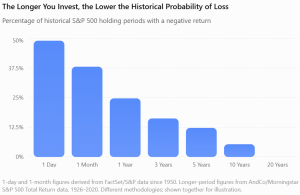
Baseball works much the same way. One bad game, one losing streak or one terrible inning doesn’t determine a team’s success or failure. What matters is what they accomplish over the full 162-game season.
Great teams lose games. Great hitters go through slumps. Great investors have difficult periods.
Neither investors nor baseball teams should let a bad Tuesday ruin the season.
Outsized Winners – Home Runs
Investments that provide extraordinary returns over short periods are rare, and you’re fortunate to find a few truly exceptional winners over an investing lifetime. Fortunately, you don’t need a portfolio filled with home runs to be successful.
Home runs are more common in baseball, although perhaps not common enough in Vladdy’s case this year … too soon?
They’re exciting, and they make the highlight reels, but they’re certainly not the only way to win baseball games. Singles and doubles count. Getting on base counts. And in investing, consistently compounding reasonable returns over long periods of time counts enormously.
We don’t need to swing for the fences with every investment. In fact, doing so is a pretty reliable way to increase your strikeout rate.
Investment Losses – Strikeouts
Losses are inevitable in investing, just as strikeouts are inevitable in baseball.
As mentioned earlier, what matters isn’t the outcome of any one investment selection. It’s the overall result and, importantly, minimizing the impact of the decisions that don’t work.
Every batter will strike out many times over the course of a season. The objective isn’t to eliminate strikeouts; that’s impossible. It’s to make sure there aren’t enough of them to overwhelm everything else you’re doing well.
Investing works the same way. We will make investment decisions that disappoint. What matters is managing risk and ensuring no single mistake can derail the broader plan.
A strikeout is part of baseball. A losing investment is part of investing. Neither should cause any of us to abandon a sound process.
Investment Selection – Pitch Selection
As investors, we have an enormous universe of choices: stocks, bonds, cash, gold, private investments and countless variations of each. We need to determine which opportunities deserve our capital and their appropriate weightings based on expected return, risk, volatility and what we’re ultimately trying to accomplish.
A batter faces a similar decision with every pitch: swing or don’t swing?
Understanding what the pitcher is likely to throw matters, but so does the discipline not to swing at every pitch.
Investing presents us with new pitches every day: new companies, new technologies, new products and the occasional investment we’re assured “can’t miss.”
Sometimes the best decision is simply to keep the bat on your shoulder.
The discipline to pass on an investment can be every bit as important as the decision to invest. As Yogi Berra said, “You can observe a lot, just by watching.”
Playing the Long Game
These are only five analogies, and I’m sure there are many more. But they illustrate how similar investing and baseball can be when it comes to creating successful outcomes.
Both reward patience, preparation, discipline and consistency. Both involve mistakes and uncertainty. And neither requires perfection.
I think the same principles apply to almost any element of life or task we undertake. There is no single approach that must be followed to be successful, but I believe having a disciplined process, and sticking with that process through both good and difficult periods, is paramount to creating a high probability of success.
In life, you don’t need to get a hit every time. You don’t need to hit home runs. You’re going to strike out occasionally.
And you certainly shouldn’t judge the season by one at-bat.
We take very seriously the responsibility you’ve placed in us to manage your wealth and help guide your financial decision-making.
Our job is to simplify the complex, filter out the daily noise, keep the short term in perspective, and help you stay focused on successful long-term outcomes.
In baseball terms, we’ll keep trying to get on base.
The home runs are a bonus.
Go Jays!

