
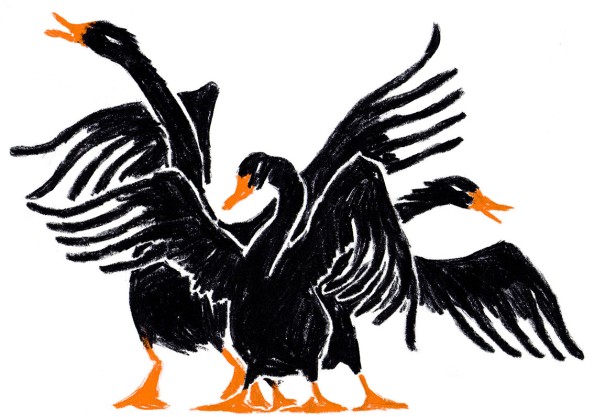
In economics and financial markets, unexpected events play an outsized role. Black Swans are rare but have an outsized impact, while Fat Tails highlight the all-too-common frequency of extreme deviations from the norm. The US Trade War has elements of both and provide us with a reminder of why surprises are inherent in today’s complex world.
Black Swans: Rare but Consequential Events
Popularized by Nassim Nicholas Taleb in The Black Swan (2007), these events:
- Are outliers, far beyond normal expectations.
- Have an extreme impact, perhaps altering markets or geopolitics.
- Appear retrospectively predictable, even if they are often unanticipated.
I am not wanting to make light of the US Trade War, but it is important to note that not all Black Swans are bad. An amusing example of a Black Swan is Balloon Fest ‘86, where the United Way of Cleveland released 1.5 million balloons as part of a celebratory fundraising event, which led to air traffic disruption, rescue failures, environmental damage and countless lawsuits—an unintended fiasco proving that even well-intentioned events can have unforeseen consequences. (1)
While we cannot yet definitively declare the US Trade War a complete Black Swan…lets agree to call it a Grey Swan for the time being…its widespread and severe potential impact demonstrates the nature of Fat Tails in economic shocks.
Fat Tails: The Probability of Extreme Events
Fat Tails occur when extreme events happen more frequently than one would normally predict. As any long-term investor can attest, real-world data shows that economic crises, stock market crashes, and yes, trade conflicts, occur more often than standard models expect.
A humorous yet relevant example of Fat Tails is Australia’s “Great Emu War” of 1932. Faced with emus ravaging farmland, the Australian military sent soldiers with machine guns to cull them. (2) However, the emus outran and outmaneuvered the military, rendering the operation a laughable failure. What seemed a simple problem ballooned (reference intended) into a volatile crisis, illustrating how small issues can spiral unpredictably.
The US Trade War (which we are hopeful is rendered a “Tariff Tiff” as we work to satisfy US demands during a 30-day delay process), is a prime example. Initially assumed to be a minor dispute, the sudden imposition of tariffs on key Canadian economic sectors like, automotive, lumber, and agriculture by the US, followed by Canadian retaliatory tariffs, created widespread supply chain challenges, investor uncertainty, and political strife far beyond early predictions.
Surprises and the Fragility of Assumptions
Both Black Swans and Fat Tails remind us that assumptions about stability are often misguided. Last week Morgan Housel (in a podcast unrelated to tariffs) explained that “the correct lesson to learn about surprises is that the world is surprising.” (3) In other words, we should never be surprised that surprises occur. However, to our collective detriment, governments, businesses and regular folks operate with models that assume predictability.
The US Trade War was a surprise to investors and policymakers who believed deep economic integration, coupled with fairly comprehensive studies that show that there are no winners in a trade war, would prevent such a conflict. However, a renewed wave of US protectionism and shifting political pressures overturned decades of trade stability. Canada, relying on its long-standing alliance with the US to ensure trade security, was caught off guard when aggressive tariffs were ceremoniously proclaimed.
Lessons for the Future
The trade war serves as a lesson in preparing for Black Swans and Fat Tail events. Simply put, governments, businesses and investors must build resilience to withstand economic shocks.
- Diversification and Risk Management: Businesses that relied solely on US-Canada trade are scrambling for alternatives when tariffs hit. A diversified trade portfolio reduces reliance on a single market.
- Avoiding Overconfidence in Stability: Just because a trading relationship has been stable for decades does not mean it will remain so. Unexpected shocks can and do occur.
Let me emphasize this point with an example that we are talking to clients about on a daily basis: Stock market volatility over the past two years has been quite low: about 17% less than the average. (4) Consequently, we have a tendency to normalize the experience of 2023 and 2024 and assume that it will be that way in 2025 and into the future. Of course, the more logical conclusion is that we will revert to the mean and we should instead expect market volatility to return.
Black Swans, Fat Tails, and Surprises help explain why economic disruptions—like the US Trade War—often unfold in unpredictable ways. Rather than trying to predict the future with false confidence, the best strategy is to prepare for the unexpected by building resiliency and investing in companies that can thrive in our new economic environment.
As always, if you have any questions, we are happy to share examples of how your investments are positioned to mitigate risks and take advantage of current markets.
-CHRIS
[1] https://en.wikipedia.org/wiki/Balloonfest_%2786, which got me thinking about WKRP in Cincinnati, “As God is my witness, I thought turkeys could fly.” [2] https://en.wikipedia.org/wiki/Emu_War [3] January 29,2025, “All the Different Ways your Life Could Have Turned Out”. [4] CBOE (the “VIX”) yearly average is 19.5. 2023 was 16.85 and 2024 was 15.55.
