
When we encounter frothy or volatile market conditions, it’s reassuring to revisit the value of diversification. While we’ve discussed this topic before, I believe it remains the single most important element in achieving your financial goals. So, let’s take a moment to review what diversification means, using today’s markets as our backdrop.
In simple terms, a properly diversified portfolio has two essential components:
- Alignment with Your Goals and Risk Tolerance: Your portfolio should match your needs, your tolerance for volatility, and your investment timeline.
- Diverse Asset Allocation: Your portfolio should balance stocks and bonds across different markets, sectors, and regions.
The key is to optimize investments according to both of these factors. This is why each client’s portfolio is unique, reflecting their individual goals and situations. It’s also why we regularly check in with you, to stay updated on what’s happening in your career, family, and personal life.
There’s a well-known saying in investing: “Diversification is the only free lunch.” But even this “free lunch” has trade-offs. By diversifying, we’re not aiming to maximize returns but to optimize them. If we were solely focused on maximizing returns, we’d simply invest everything in one stock. For example, NVIDIA has risen 198% this year—a perfect pick in hindsight.[1] But how many investors would risk everything on one stock? Very few, and for good reason.
Consider another approach: instead of a single stock, investing in a broad index like the S&P 500, which is up 26.17% this year.[2] The S&P 500 has been a top performer, boosted recently by expectations tied to new policies from Republican wins in the White House and Senate. At first glance, holding 500 stocks seems like a safe bet. But here’s a catch: a significant portion of this year’s return has come from just seven companies, known as the “Magnificent 7.” The other 493 stocks have contributed minimally, which should give us pause.
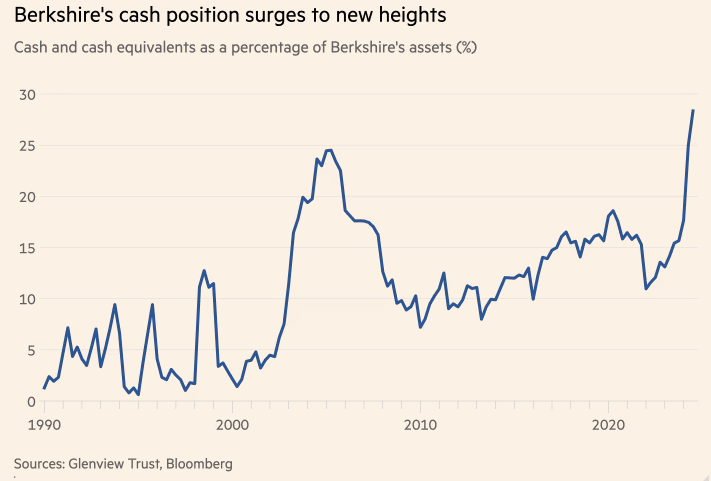
This situation brings to mind Warren Buffett’s wisdom: “Be fearful when others are greedy, and be greedy when others are fearful.” Right now, Berkshire Hathaway’s substantial cash holdings—often a cautious signal—reflect this sentiment.
Additionally, Goldman Sachs forecasts just a 3% annualized return for the S&P 500 over the next decade, barely above expected inflation.[3] And another analysis from highly regarded Apollo, using different metrics, reached a similar conclusion.[4]
This doesn’t mean we should avoid U.S. equities—far from it. We want exposure to both U.S. technology leaders and other strong companies, while also diversifying internationally to capture opportunities in different regions. With this balanced approach, we aren’t overly reliant on one sector, market, or prediction.
In other words, a well-diversified portfolio allows us to “take the fork in the road” no matter which way the market turns.
– CHRIS
[1] As at November 12, 2026
[2] Ibid.
[3] https://www.wealthprofessional.ca/investments/etfs/goldman-predicts-3-return-for-sp-500-over-the-next-decade/387336#:~:text=Goldman%20Sachs’%20equity%20strategy%20team,index%20over%20the%20next%20decade.
[4] https://www.apolloacademy.com/low-returns-expected-in-the-sp-500-over-the-coming-years/

