
“One of the penalties for refusing to participate in politics is that you end up being governed by your inferiors.” – Plato
2024 has not been lacking in headline news! Whether environmental, financial, or political, we’re sure you’ve been glued to the media, just as we have been trying to keep up with all the goings on in the world.
Of course, our neighbours to the South are in an election year. From the assassination attempt and the Republican National Convention to the Democratic leadership change and the star-studded DNC, the US election race is providing plenty of headline news. With all of the sensationalism and the heightened bipartisanship, the question that begs to be answered is: Does any of this matter to your portfolio returns over the next year, four years, or beyond?
Let’s examine what history tells us about market returns during election years.

In addition to the above, we can add that in 2020, Biden was elected, and the S&P 500 return was 18.4%. Does the above mean there is an 83% chance that we will experience another positive market return in this election year? It looks that way, but we’ll have to wait and see. We find comfort in Sir John Templeton’s wisdom and statement that the most dangerous four words in investing are “this time is different.”
Here’s a look at what has transpired over entire Presidential terms. We’ve highlighted the Presidents who served for 96 months—the maximum eight years a president can serve. As you can see, FDR was the only president to serve four terms, primarily due to circumstances that spanned a period that followed the Great Depression to the end of WW II. The Presidents who served and had negative market returns over their terms were Hoover, Nixon, Carter, and GW Bush.
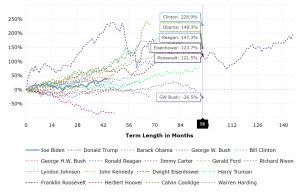
If you’re interested, here is a link to the tool that will allow you to look at the Presidents and time frames that might interest you.
https://www.macrotrends.net/2481/stock-market-performance-by-president
In July of this year, Fidelity wrote a commentary addressing the question: Do election results matter to the market? They stated that whenever a US presidential election rolls around, it’s not uncommon to hear it described as “unprecedented.” Their findings largely agree with what has already been stated; however, they did have five key takeaways to share[1]:
- Historically, US markets have generally risen in election years. “Politically driven economic cycles are more relevant to emerging-market economies or economies with weaker institutions…They’re not as relevant for developed markets like the US.”
- Down-ballot races may be highly consequential. “There are slim margins in both bodies of Congress…Those down-ballot races will help determine whether the next 2 years are spent under divided or unified government, and will likely impact how much of its agenda the next administration is able to accomplish.”
- Betting on the specific policy of sector impacts can be highly risky. “While it’s possible to anticipate potential policy impacts at a very high level, the reality is that at this stage no one can predict with any certainty which party will win certain institutions, let alone what sectors, industries, or stocks may benefit from the next administration’s policies.”
- Markets are nonpartisan. “Although popular myths sometimes suggest that one party or the other is “better” for market returns, the historical data does not bear out these theories…The S&P 500 has historically averaged positive returns under nearly every partisan combination…And in fact, there’s some evidence that divided government has historically correlated with stronger market returns—perhaps because government gridlock creates less policy uncertainty.”
- Investors should focus on fundamentals and stick with their plans. “Market moves are more likely to be driven by market and economic fundamentals, such as corporate earnings, interest rates, and other economic factors.”
We are indeed living in exciting and somewhat controversial times. When I say this and look back on my fifty-two years, one of the critical lessons that I have learned is to never base your investment policies and financial decision-making on the political policies and rhetoric of the day. If you were to rely on the political environment, you would likely never find yourself in a position to make any decisions!
So, whether a Democrat or a Republican, a woman or a man, is sworn into the Oval Office in the US election, businesses will continue to innovate and provide goods and services, just as they have always done. Our job is to partner with management teams that can find opportunities to grow your hard-earned dollars regardless of the political landscape.
We will eagerly watch history unfold this November and remind ourselves that optimism has always been the only true realism!
Have a great weekend – ERIC
[1] https://www.fidelity.com/learning-center/trading-investing/election-market-impact

