

The greenback, Benjamins, dead presidents – it goes by many names, but we all know it refers to the all-mighty U.S. Dollar. As the world’s reserve, and most important currency, the U.S. Dollar affects us all. About half of global trade is invoiced in USD, and nearly 60% of central bank reserves are held in the same currency, showing that the dollar continues to dominate both transactions and treasuries alike.[1]

With the U.S. election looming, a particular issue caught my eye: Is the dollar too strong, and can the executive branch of the U.S. government do anything to manipulate its value? As Canadians, we often think about the gains associated with a strong Canadian Dollar, why would Americans not want the same thing? As with most things, a strong U.S. Dollar has its pros and cons.
Before we dive into the question, let’s take a moment to look at how the U.S. Dollar became the world’s currency. The U.S. Dollar became the world’s reserve currency primarily after World War II, when the 1944 Bretton Woods Agreement established the dollar as the global standard for trade and finance. At the time, the U.S. had the largest economy and held the majority of the world’s gold reserves, making the dollar strong and stable. Under the agreement, other currencies were pegged to the dollar, which was convertible to gold. Although the gold standard ended in 1971, the dollar retained its status due to the size of the U.S. economy, political stability, its widespread use, and its status as a safe asset for central banks.
Today, most businesses, even those with no direct ties to the U.S. transact in international markets with the U.S. Dollar. The most vital commodities from oil and gold, to sugar and cocoa, trade mainly on the U.S. Dollar.[2] If Thailand wants to buy oil from Nigeria, that transaction is made in U.S. Dollars.
So how did we get such a strong dollar and what does that mean for Americans?
Following COVID, interest rates were raised in response to high inflation, attracting capital from all over the world.[3]
When the dollar is strong, it makes American consumers very powerful on the global stage. Goods from foreign places are significantly cheaper. Everything from a high-end Italian handbag to an already cheap computer made in China are that much cheaper. Americans who travel internationally will be able to spend a lot more. Most importantly, it makes American capital markets very attractive.[4]
Enbridge, Lululemon and TD are all examples of Canadian companies which trade on American exchanges (note that Enbridge and TD also trade in Toronto). Obviously, a strong U.S. Dollar strengthens an investor’s returns when they convert the profits back to their local currency.[5]
On the flip side, this makes American goods more expensive and less competitive internationally. This puts a strain U.S. manufacturers, slows business, and potentially leads to job losses—casting a shadow on the broader economy. Manufacturing layoffs occurred in large numbers in the 80s and 2000s due to a strong dollar.
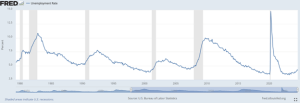
Traditionally, the U.S. President tries not to influence the U.S. Dollar, since there are winners and losers depending on the dollar’s strength. But there have been exceptions. Nixon suspended the gold standard in 1971[6] and in the early 1980s Reagan coordinated with other powerful nations to coordinate the sale of their U.S. Dollar reserves.[7] This increased the supply of the Dollar, pushing its value down. In the graph above, you can see that this successfully pushed U.S. unemployment downward.
With the above evidence, coupled with the fact that several of the swing states are dominated by the manufacturing sector, it seems fairly obvious as to why this year’s U.S. Presidential candidates are musing about a weaker U.S. Dollar.
So how does this affect Canadians?
With America as our largest trading partner, at over $2.5 Billion U.S. Dollars per day, a strong U.S. Dollar makes our goods more appealing to consumers south of the border, boosting our manufacturing sector.[8] Conversely, it makes imported goods more expensive for us, regardless of their origin.[9] For instance, Apple reports its revenue in U.S. Dollars, even though its phones are manufactured in Asia. To maintain shareholder satisfaction, the company often raises prices in other markets, which can drive up costs for consumers. And for those of you who holiday south of the border, that trip is becoming ever more expensive.
Typically, a strong U.S. Dollar benefits provinces like Alberta, Saskatchewan and Newfoundland because their economies are dominated by the export of natural resources that are priced in U.S. Dollars. Conversely, provinces like Ontario and Quebec benefit from a weaker U.S. Dollar because they are exporting manufactured products which are more affordable to U.S. consumers.
So, is a weaker dollar a bad thing? Canadian or American, it all depends on who you ask!
– SHIV
[1] https://www.bis.org/publ/qtrpdf/r_qt2212x.htm
[2] https://www.cnbc.com/futures-and-commodities/
[3] https://www.forbes.com/advisor/investing/strong-dollar/
[4] https://www.npr.org/2024/06/11/nx-s1-4990256/strong-dollar-overseas-travel-currency-exchange-rate
[5] https://www.nyse.com/listings/international-listings
[6] https://www.federalreservehistory.org/essays/gold-convertibility-ends
[7] https://www.forbes.com/sites/richardsalsman/2011/08/16/gold-reagan-and-the-reds-from-degraded-dollar-to-downgraded-debt/
[8] https://www.trade.gov/knowledge-product/canada-market-overview#:~:text=Canada%20is%20traditionally%20the%20top,in%20goods%20and%20services%20daily.
[9]https://www.morningstar.ca/ca/news/250763/how-a-weaker-loonie-impacts-canadian-consumers-and-investors.aspx

