
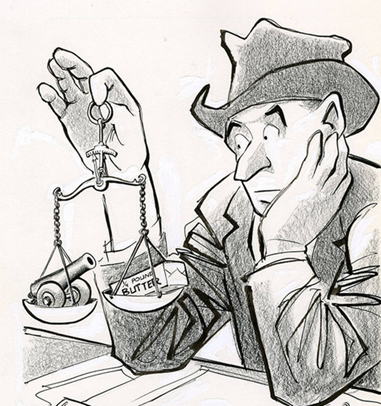
In times like these, I find it helpful to reflect on past financial crises, such as the 2008 crash and the COVID-19 pandemic. Both events triggered significant market downturns, and at the time, it felt as though the world was on the brink. However, markets eventually recovered—as they always do! What remains most important in times of uncertainty is staying committed to your financial plan, maintaining discipline, and focusing on the long-term.
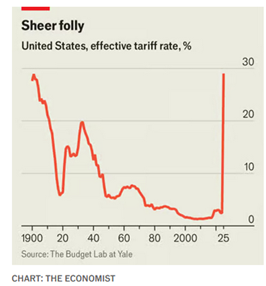
With so much uncertainty in the news, it’s important to take a step back and distinguish between market fluctuations and your personal investment strategy. The good news is that, for the most part, our clients have remained relatively flat this year, despite the uncertainty in financial markets. This reinforces the value of our carefully chosen investment partners.
One of our most trusted partners, EdgePoint, shared a timely reminder this morning about their investment philosophy. They focus on resilient businesses that are well-positioned to navigate uncertainty. In times like these, their disciplined approach becomes even more crucial, as they actively seek opportunities to capitalize on the missteps of others during periods of market turbulence.
If you’re looking for some reassurance during these uncertain times, I encourage you to read Tye Bousada’s thoughtful insights HERE.
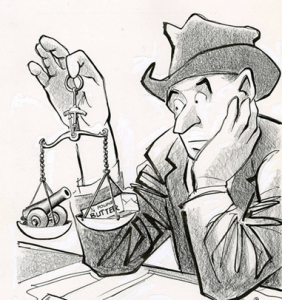
Guns N’ Butter
The world order has experienced rapid change in the last few months. The new US administration has been putting pressure on its allies to increase military spending. While this sounds straightforward, like most things in life, there’s a trade-off. As Biggie Smalls once said, “Mo’ money, mo’ problems.” The more you focus on one area, the more you have to balance the consequences in others.
Prime Minister Margret Thatcher once said “The Soviets put guns over butter, but we put almost everything over guns.” She was referring to the economic concept of guns and butter. [1]
Governments, much like individuals, operate within financial constraints. The ‘guns and butter’ economic model illustrates the trade-off between military expenditures and domestic investments (healthcare, infrastructure, and social welfare, etc). [2]
The concept is best illustrated visually:
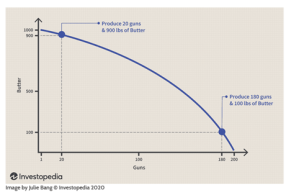
The graph depicts the trade-off between military and domestic spending. Given finite resources, an increase in military production necessitates a reduction in domestic expenditures. The blue line illustrates the maximum feasible output combinations. Any point below the blue line is attainable but signifies underutilized resources. Points along the blue line indicate optimal efficiency, where all resources are fully utilized. Conversely, any point beyond the blue line is unattainable, given current resource constraints. [3]
President Lyndon B. Johnson attempted to fund both military efforts (the Vietnam War) and domestic programs simultaneously, effectively pushing beyond the Production Possibility Frontier (PPF). While this approach was theoretically possible through deficit spending, it came at a cost—rising inflation, which hit 5.75%. Turns out, trying to have your cake and eat it too just makes everything more expensive… including the cake! [4]
NATO guidelines state that members spend at least 2% of GDP on defense. While some nations spend above 2%, many do not, including Canada.
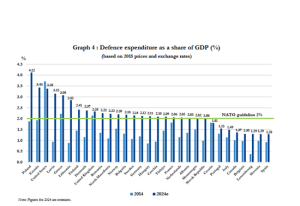
Canada currently allocates 1.34% of its GDP—approximately $39 billion annually—to national defense. Meeting NATO’s target of 2% would require an additional $19 billion in funding, necessitating trade-offs in other areas of government spending. This presents policymakers with difficult decisions, as increased defense expenditures could come at the expense of social programs and public services. [5]
It is important to note that, despite allocating only 1.34% of GDP to defense, Canada ranks as the sixth-highest defense spender among NATO’s 32 member states due to the size of our economy.
Let’s quickly address the elephant in the room. I’m writing this just hours after the U.S. administration released its long list of tariffs. Most of you are probably aware by now—but to put it mildly, the markets are looking a bit shaky. [6]
Special Announcement
To conclude on a positive note, I’m excited to introduce a new addition to our team at TFP. Mat Pepin, who has joined us as an associate advisor.
Mat was born and raised in North Bay and brings valuable experience from his time working at local financial institutions, where he provided financial services to clients. Outside of work, Mat is a devoted family man and an outdoor enthusiast. In coming weeks, he will be sharing more about himself in his first commentary.
Take care and have a great weekend,
Shiv
[1] Reuters – Analysis – Even Oil Rich Russia Can’t Afford Guns and Butter
[2] Guns and Butter 2.0 [3] What Does ‘Guns and Butter’ Mean in Government Spending? [4] Obama learns LBJ’s hard lesson: You can have guns or butter, but not both [5] Defense Expenditures of NATO Countries 2014-2024 [6] Trump takes America’s trade policies back to the 19th Century
