
I don’t know about you, but I can’t keep up with the news anymore. Tariffs this, tariffs that. What land is America trying to conquer next? Is NATO still a thing? I’m exhausted!
I thought I’d focus on an often-forgotten region of the world and help relieve our minds of the daily bombardment of North American geopolitical affairs. I promise there will be no mention of tariffs!
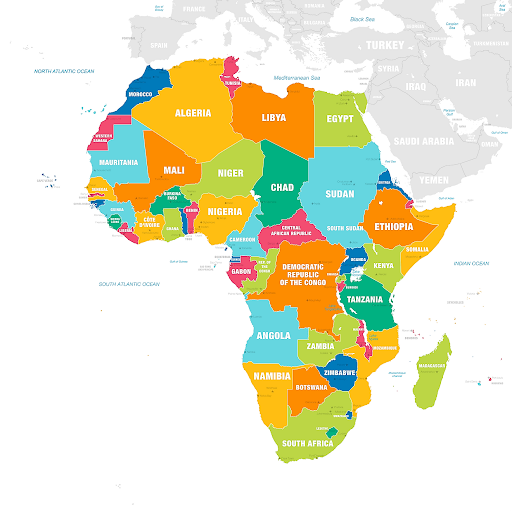
Africa is transforming. Life expectancy is up, infant mortality is down, and education is rising. By the century’s end, most of the world’s population growth will be centered in Africa, driving major social change. But economically? That’s a different story. [1]
In 1990, Africa had 14% of the world’s poor. By 2030, that number could reach 80%, largely due to the economic boom in China and South and South East Asia during that time. [2]

In 1960 the African GDP per person adjusted for purchasing power was around half of the average in the rest of the world. Today, it’s a quarter.

There have been some bright spots on the continent (Ghana, Ethiopia and Rwanda) but they are the exceptions rather than the rule. Most of Africa’s growth still lags behind the rest of the world. [1]

Nearly half of Africa’s countries face inflation over 50%, soaring debt costs, and dwindling foreign reserves—barely covering three months of imports, per the IMF (International Monetary Fund). Meanwhile, foreign investment and aid are shrinking. [3]
Why isn’t growth in Africa keeping up with the majority of the developing world?
Productivity growth in Africa is lagging. As countries develop, workers typically become more skilled, generating more income per hour—like China’s shift from farming to industry in the ’90s. But in Africa, this transformation hasn’t happened, according to the World Bank. Farming, a major industry, remains stagnant. While South Asia doubled cereal yields from 1980 to 2018 without using more land, sub-Saharan Africa tripled yields—but only by more than doubling land use. [4]
As manufacturing becomes more dependent on robots and less on human capital, Africa has also missed the opportunity to become a manufacturing powerhouse like China, Vietnam, or Bangladesh.
Africans are shifting from agriculture to the services industry, but unlike other developing nations, most aren’t entering corporate jobs. Instead, 80% of employment remains informal—think street vendors, market stalls, and cash-paid work. [4]
That leads to business creation. Many businesses…. Way too many businesses. [5]
Most African businesses are small, low-revenue, and inefficient. The continent lacks large firms that drive efficiency and wealth through scale. Africa has just 345 companies generating over $1B in annual revenue—about 60% of the expected number, according to McKinsey, a consultancy. [6]

The scarcity of democratic regimes across the continent is a significant concern. The Economist Intelligence Unit classifies only 6 of Africa’s 54 nations as full or flawed democracies (for reference, Canada is considered a full democracy, while the US is considered a flawed democracy), contributing to corruption and inefficient capital allocation, ultimately hindering economic growth. [7]
Africa attracted only $53 billion in foreign direct investment (FDI) in 2023, representing a mere 4% of the global total. Caught between Western influence and China’s growing presence, particularly through initiatives like the Belt and Road, African nations face a critical decision. While China has increased its investment, it still trails the West. The continent’s trend towards authoritarianism may further incentivize engagement with China, creating a potential opportunity amidst this great power competition. [8]
Under current trends, Africa’s GDP per capita is projected to reach only a quarter of the world average by 2043, effectively implying no growth relative to the rest of the world and condemning 400 million to extreme poverty. [8]
Despite these challenges, Africa possesses a significant advantage: its projected population growth. With the world’s working-age population increasingly concentrated on the continent, Africa has the potential for substantial economic growth. Realizing this potential, however, requires embracing democracy, fostering the growth of larger firms, and efficiently allocating labor and capital. [9]

Told you I wouldn’t talk about tariffs!
[1] The Economist Special Report – Jan 6 2025 [2] World Bank [3] IMF [4] The Economist Special Report – Jan 6 2025 [5] The Economist Special Report – Jan 6 2025 [6] McKinsey [7] EIU [8] The Economist Special Report – Jan 6 2025 [9] The Economist Special Report – Jan 6 2025
Shiv Mohan

