
As a true millennial (born 1981-1996), I occupy an unenviable position: lectured by older generations and mocked by younger ones. We are, it seems, the punching bag of the demographic spectrum. “Stop eating avocado toast if you ever want to afford a house,” the older crowd advises. “Why do you dress like that?” asks Gen Z.
Yet the joke may be on them. Not only is our fashion sense impeccable, but more importantly, we are earning more than previous generations did at the same age, enjoying comparable rates of homeownership and increasingly running the companies that shape the world. We have gone from setting pop-culture trends to setting corporate strategy. [1]
Not bad for a generation that entered the workforce just as the global financial crisis was busy setting the world on fire.
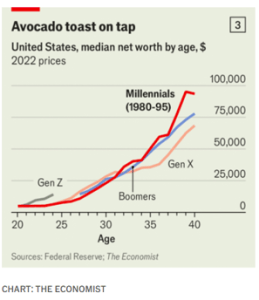
The numbers make for encouraging reading. Adjusted for inflation, millennials’ disposable incomes are higher than those of previous generations at the same stage of life.

No wonder Americans in my cohort spent $1.5bn on avocados last year. Apparently, we can afford the guacamole after all. [2]
Of 32 wealthy countries examined, only three, Japan, Greece and Italy, have seen millennials fare worse in inflation-adjusted income terms than their predecessors at the same age. In the other 29, including Canada, we are outearning the very people who criticize our brunch habits. The avocado, it seems, has been unfairly maligned. [2]
Our rise is visible beyond the payslip. Millennials account for more than twice the share of American billionaires than Gen X (born 1965-1980) did at the same age. We are just as likely to be managers as Gen X was at this point in life, and we are at the forefront of the artificial-intelligence revolution. The bosses of Anthropic, OpenAI and Meta are all millennials. [2] Proving we can manage more than the complicated coffee orders we love.
Politics is gradually opening up, too. The leaders of the Netherlands and Hungary are millennials, while betting markets have put the odds of America’s next president being a millennial at roughly even. We have not quite taken over the world, but we seem to have secured a place on the shortlist.
Millennial success has implications beyond our own bank accounts. As more people work and earn more, governments collect more tax revenue to help fund pensions and healthcare services on which all generations depend. The generational relationship, it turns out, is not entirely one-way. We may be buying the occasional overpriced brunch, but we also help keep the public finances ticking along.

Housing, admittedly, has been a slower story. At 30, millennials lagged behind previous generations in homeownership. Years of student debt, expensive housing and the general inconvenience of entering adulthood during a financial crisis did not help. But patience has paid off. By age 40, millennials had caught up with Gen X in homeownership rates across the OECD, a club of mostly wealthy countries. [2]
And did I mention that millennials are the most educated generation? All those degrees had to be good for something, even if the student-loan payments occasionally suggested otherwise. [1]
As homeownership has improved, so has our wealth. Millennials’ net worth now outpaces that of previous generations at the same age. The generation once accused of frittering away its future on electronic gadgets is, rather inspiringly, accumulating assets. [2]
Millennial cultural influence is also hard to miss. The entertainment we grew up with is enjoying a second life, often with a considerably larger budget. Mario and Luigi, once confined to eight- and sixteen-bit worlds, now enjoy big-screen adventures in glorious three-dimensional form, voiced by Hollywood stars. The Devil Wears Prada 2 had out-grossed the 2006 original. Oasis had the second highest grossing tour of 2025. Jay-z will be performing the Super Bowl halftime show. Even the nostalgia industry has discovered that millennials are a lucrative audience. We are old enough to remember the originals and young enough to buy tickets to the sequels. [3]
Our fashion choices are making a nostalgic second appearance in Gen Z wardrobes (born 1997-2012) while we are bringing back the 80s looks we were too young to wear!
So don’t feel bad for us. You can find me in my house, with more avocados than a Chipotle, debating with Chat GPT on whether to buy oat or almond milk from Amazon.
-SHIV
[1] https://www.economist.com/leaders/2026/10/15/millennials-success-deserves-a-toast-not-the-avocado-sort [2] https://www.economist.com/finance-and-economics/2026/10/11/dont-feel-sorry-for-millennials-they-are-living-it-up-now [3] https://www.economist.com/culture/2026/10/15/squeeze-into-those-skinny-jeans-millennial-culture-is-back

