
Before sharing a cautionary tale, we want to highlight a wonderfully practical book: “Let’s Talk About Aging Parents: A Real-Life Guide to Solving Problems with 27 Essential Conversations.” Written by Ontarian Laura Tamblyn Watts, it’s a comprehensive resource for navigating the issues and emotions that arise as we help our parents in their later years.
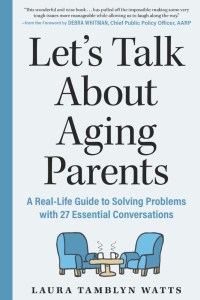 This isn’t a book you read from cover to cover. It’s a handy reference for life’s messier moments. Let me share some of the topics covered:
- Do Mom and Dad need help around the house? The book has a comprehensive checklist of common household tasks.
- Is it time to discuss Dad’s ability to drive? The book offers six different strategies (seven if you count the one titled “If nothing else works”).
- Not sure how to broach the subject of Mom’s hearing loss? The book outlines the pros and cons of seven different types [WHO KNEW!] of hearing aids.
Simply put, if you are wondering where to start in dealing with 27 common aging issues, “Let’s Talk” will set you on the right path.
And now for our cautionary tale.
In cases where elderly persons have more wealth than they conceivably require to see them through their lifetime, it is common for them to gift of some of the surplus assets to their children, often referred to as an “inter vivos” gift.
Occasionally, at the very end of life, it is prudent for a Power of Attorney to carefully distribute even more assets directly to intended beneficiaries before the elderly person’s passing. The benefits are clear: lower Estate Administration Tax (commonly called “probate fees”), lower or eliminated legal and accounting fees, and a faster winding up of the estate.
A B.C. Court decision issued on June 14th has raised eyebrows among lawyers and created uncertainty with this strategy across Canada. Here’s a synopsis:
“In this case, the court addressed the question of whether to allow a man who is managing his mother’s financial affairs under an enduring power of attorney to make a gift to himself, as set out in an investment plan that was crafted years earlier.
According to the decision, Eugene Derreth — who was managing his mother Doreen’s financial affairs under a power of attorney that took effect after his father died in July 2023 — sought the court’s permission to make himself a gift of $250,000 from his mother’s holdings, as the family had previously planned.
However, the court denied his application, ruling that the power of attorney [document] didn’t specifically authorize the gift. [Underlining by this author for emphasis]
“With some regret, I have concluded that the proposed gift is not lawful [under the legislation governing powers of attorney],” the court said in its decision.
While that legislation allows an attorney to make gifts, subject to certain conditions, including that the vulnerable person will have enough assets to meet their needs, an attorney can only receive a gift that is specifically provided for in the terms of the power of attorney, the court found.”[1]
In other words, without an express clause allowing for gifts specifically to the attorney, it cannot be done.
Adding to the perplexing ruling, the son was the ONLY beneficiary of the estate, and even after the gift, the mother would be left with more than $2.8 million in liquid assets. Who, in the judge’s mind, could possibly be harmed?
Believe it or not, the implications get worse. If Eugene had a sibling also supposed to get $250k, the sibling’s gift would be valid under the court’s ruling, but Eugene’s would not. Given that Eugene decides whether to gift or not, I can see the familial fireworks from here!
There’s even more to share. Many provinces, including British Columbia and Ontario, have government-approved boilerplate Powers of Attorney that cover common fact patterns. They do not, however, include a clause ensuring gifts can be made to the person acting as the power of attorney. In B.C. the impact is that the province is “blessing” a legal form that its own courts have made problematic.
A few additional thoughts:
- The court case is less than two weeks old. There is hope the ruling will be appealed and a saner bench will overturn the decision.
- For the moment, the ruling only applies to B.C. residents. Judges in other provinces may take a different approach, as the B.C. bench is typically more interventionist than the judges from other jurisdictions.
- If you live in B.C., check your Power of Attorney for a “gifting clause” and whether it explicitly allows for gifts to the power of attorney. If not, give us a call, and we can help you decide if you should contact your lawyer to draft a new Power of Attorney.
- If you do not live in B.C., we wouldn’t recommend rushing to get new documents created. However, if your existing POAs are due for updating anyway, we recommend including a “gifting” clause, just in case.
As always, if we can assist with any of the topics mentioned, please do not hesitate to give us a call. We are always happy to help.
Take care,
Eric, Rob, Chris and Shiv
Kerry, Julie, Bev, Sara, Patti, Natasha and Jen
[1] B.C. Court Rules on Limits to Powers of Attorney, by James Langton, Advisor.ca, June 18, 2024.

