
Let’s talk about what’s on everyone’s mind: the shocking news that NFL players eat over 80,000 Uncrustables throughout the season! That’s a lot of PB&J if you ask me.[1]
Ok, seriously let’s talk about the US election. Now that we’re a few weeks removed from election day, one thing is clear: Mr. Trump’s overwhelming win, coupled with the Republicans winning the Senate and the House, has granted him significant authority to reshape the world.
“When America sneezes, Canada catches a cold” – Pierre Elliot Trudeau.
Let’s dig into how the markets have reacted; discuss what effect future policies may have; and how those policies may impact Canada.
On November 5th, as the results got clearer throughout the evening, I had an eye on global markets. Around 11pm, the US dollar was getting stronger and US market futures were rising. Though nobody had called it yet, the writing was on the wall. That was confirmed when I woke up on the couch with a half-eaten pizza, early the next morning.
In the days following the election, US financial markets reacted extremely positively. From November 6th to 11th, the S&P 500 index reached record highs, even as global stocks declined by 2%.[2] The market anticipated a combination of tax cuts, deregulation and sweeping tariffs on imported goods.
Deregulation is when a government reduces or removes rules and restrictions on businesses or industries to encourage competition, innovation, and economic growth. In theory, this can boost efficiency and profitability. However, the flip side is that it allows monopolistic behavior or unsafe practices, which could ultimately stifle both efficiency and innovation. Furthermore, it may result in reduced protections for workers and the environment.[3]
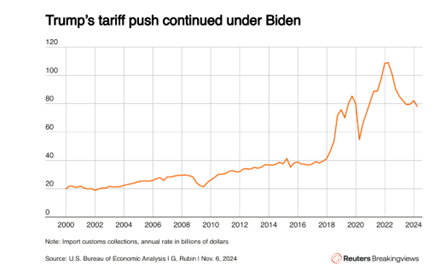
A tariff is a tax imposed by a government on imported goods to regulate trade. This cost is often passed on to the customer.
In the short term, tariffs can stimulate U.S. economic activity and generate jobs. However, over time, these same tariffs are likely to drive inflation, reducing Americans’ purchasing power and making U.S. workers less productive and competitive globally. This could further exacerbate income inequality, where the U.S. already ranks highest among G7 countries. Additionally, a stronger U.S. dollar, another consequence of tariffs, would hurt exporters and American businesses operating internationally.[4]
It’s important to note that tariffs aren’t always negative and can have bipartisan support. They can protect emerging industries until they become globally competitive and counter unfair subsidies that make local goods uncompetitive.[5]
So, what does this all mean Globally?
As America moves more inward, so will the rest of the world. Trade wars could erupt, making goods ever more expensive in global markets at the cost of innovation. Mr. Trump views trade deficits with ire. The chart below may provide some insight into what countries his administration may have its sights on.[6]
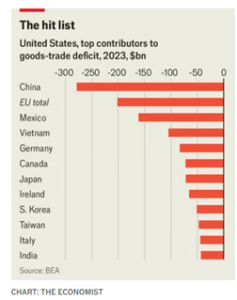
America with its large and wealthy domestic market would be more insulated against a trade war than other nations, but it, or more importantly, its citizens, would still be impacted negatively.
What about Canada?
2026 is when our free trade agreement…the exact opposite of tariffs…with the US and Mexico is up for renegotiation. The incoming administration has long pointed its finger at Mexico for taking advantage of trade with the US. This could make Canada collateral damage. Seventy-five percent of Canadian exports go to the US, meaning tariffs would make our goods less competitive in the American market, harming Canadian jobs and the broader economy.[7] Additionally, a strong U.S. dollar would drive up the cost of everyday goods we import, effectively reducing our purchasing power.
According to the Canadian Chamber of Commerce, a proposed 10% tariff would reduce Canada’s real income by 0.9% annually and labor productivity by almost 1%. If other countries retaliate, triggering a trade war, real income could drop by 1.5% annually, with labor productivity declining by nearly 1.6% per year. [8] Clearly, Trump’s proposed tariff of 25% on all Canadian goods would make these statistics even worse.
Desjardins’ economics analysts forecast that Trump’s policies would result in real Canadian gross domestic product falling by 1.7% by the end of 2028 compared to what would have happened under a Democratic president.[9]
Its hard to know how much of this is just rhetoric and speculation versus what policies will actually come to fruition. For those of you worrying, I’d refer you to Eric’s commentary a few months ago. Markets are nonpartisan and investors should focus on fundamentals and stick with their plan. Regardless of how the next four years play out, we are confident our investment partners are well-positioned to navigate the markets. As Geoff MacDonald of Edgepoint mentioned to us this week, ‘You can invest in Canadian companies, but you don’t necessarily want to invest in the Canadian consumer.’[10]
——————————-
Lastly, some of you may have read that our parent company, CI Financial, will cease to be a publicly traded company in 2025.
We are excited about the announcement and think its positive news for clients, advisors and shareholders. The firm has been looking to go private for some time now and Mubadala is a non-bank partner that has no intention of changing our business or becoming involved in daily operations. There are three interesting aspects to the transaction: there is no debt being created with the transaction; none of the management personnel are being replaced; and Mubadala is injecting $750M into the business to retire existing debt and invest in future growth. We are pleased with each of those factors.
Have a great weekend!
-SHIV
[1] https://www.foodbeast.com/news/nfl-players-eat-over-80000-uncrustables-throughout-the-season/
[2] https://www.economist.com/finance-and-economics/2024/11/14/china-europe-mexico-the-biggest-losers-from-trumponomics
[3] https://www.reuters.com/markets/us/trump-victory-reverberate-through-global-economy-2024-11-06/
[4] Ibid #3
[5] https://www.reuters.com/breakingviews/trump-re-election-entrenches-global-instability-2024-11-06/
[6] Ibid #3
[7] https://www.reuters.com/world/americas/trumps-victory-adds-trudeaus-challenges-canada-2024-11-06/
[8] Ibid #2
[9] Ibid #2
[10] Geoff McDonald, November 27,2024.

