

2023 was a strange year. Markets were good, then bad, then good again. The economy was bad, then good, then bad. That’s not even mentioning all the strange geopolitical events throughout the world: from Poland tossing out a far-right government; a new war in the Middle East; to Argentina electing a chainsaw-wielding, self-described anarcho-capitalist as their leader (with sideburns that would make Wolverine envious). A lot happened in 2023. All of that recession talk never came to fruition and global GDP rose by 3%.[1]
Some of you may have read my commentary last year around this time about how Canada did in various economic metrics versus our peers. I thought it might interest some of you if I were to replicate the exercise 2023.
Ok, so how did Canada do last year? As the kids say, it’s complicated.
For an exercise like this, it’s always good to take data in context. I will do this by comparing it to a select group of OECD countries (a group of developed nations).
First, let’s delve into inflation, a topic that has been at the forefront of our minds for the past few years. Let’s specifically take a look at core inflation, which strips out volatile items such as energy and food. Prices rose 3.7% last year.1 Not bad, but also not great. While this figure did trend in the right direction, we are still far off our central bank’s target of 2%. Major contributions to this figure are rent and vehicle prices. Looking at our peers, we slot in right in the middle of the pack.[2]

Next, let’s examine the most well-known economic indicator: gross domestic product, or GDP. GDP serves as the primary measure of a nation’s overall economic output. Put simply, the number equates to the total amount of income of all people within that nation. Comparing this figure over time can show us if our economy is growing, shrinking or stagnant.
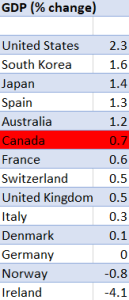
Canada’s economy grew 0.7% in 2023.1 You can’t sugarcoat data. Exports got hit hard, especially those in the agriculture, mineral and energy sectors.[3] This tells us that our goods are becoming less competitive in international markets, as we lose market share. Geopolitics has also affected our economy. Our biggest trading partner, the US, has started to look inward within the last few years. Protectionism on both sides of the political divide is causing America to shun global markets and opt for homegrown goods with the help of subsidies and import taxes.[4]
Unfortunately, we underperformed relative to our peers. Both South Korea and Japan had growth of over 1% a year. Both of these nations are famous for low growth and flirt with deflation.[5] Meanwhile, the US has done exceptionally well, with growth more than 3x higher than ours largely due to high levels of energy production and large stimulus packages in previous years.[6]
If we change focus and look at employment, we will see that also increased by 1.6%. last year1
We did better than most, but that doesn’t tell us much without digging a little deeper.

Population growth outpaced employment gains, meaning that even though our unemployment rate didn’t change much, our labour force participation rate did. Unemployment figures do not account for those not looking for work. Labour force participation helps us get a more accurate reading. This figure gives us a relationship between people who can work and those who are working. Data from Stats Canada shows us there has been an increase of 20% in unemployed individuals. [7]
Lastly, how did our stock markets perform?
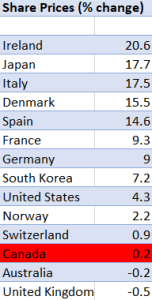
We fell way short of our peers with a gain in share prices of 0.2%. The figure below does not represent the TSX composite index that did better. That index does not take into account every publicly traded firm in Canada. Rather that number represents a weighted average of all stocks, adjusted for inflation. Our markets are heavily concentrated in dividend-value stocks. As interest rates rise, these stocks become less attractive. Examples of these are banks and energy stocks. Unfortunately, Canadian markets lagged far behind our peers.[8]
2024 is shaping up to be very consequential. This year more people will vote in elections worldwide than at any other point in history. At least 64 countries, which make up almost half of the world’s population will visit the ballot box. A few of these elections have already occurred, such as Taiwan, where a pro-West, anti-China candidate was victorious. While not all of these elections will be free and fair, most will. Oh, and I almost forgot, in November, our neighbours to the south head to the polls. The results of that election will have worldwide consequences that will be felt for some time.[9]
So, what’s going to happen in 2024? To borrow the wise words of Kramer, “Why did they ask you for your phone number when you bought batteries at Radio Shack? I dunno!”

Eric, Chris, Rob, & Shiv
- [1] https://www.economist.com/finance-and-economics/2023/12/17/which-economy-did-best-in-2023
- [2] https://www150.statcan.gc.ca/n1/daily-quotidien/240116/dq240116a-eng.htm
- [3] https://www.international.gc.ca/trade-commerce/economist-economiste/q2-2023.aspx?lang=eng
- [4] https://www.economist.com/finance-and-economics/2023/01/09/what-americas-protectionist-turn-means-for-the-world
- [5] https://www.reuters.com/markets/asia/japans-economy-slips-into-recession-weak-domestic-demand-2024-02-15/
- [6] https://www.whitehouse.gov/cea/written-materials/2023/12/19/ten-charts-that-explain-the-u-s-economy-in-2023/
- [7] https://www150.statcan.gc.ca/n1/daily-quotidien/240105/dq240105a-eng.htm
- [8] https://www.bnnbloomberg.ca/canadian-stocks-erase-year-s-gains-fall-further-behind-us-peers-1.1979284#:~:text=(Bloomberg)%20%2D%2D%20Canadian%20stocks%20erased,further%20behind%20their%20US%20peers.
- [9] https://time.com/6550920/world-elections-2024/

