
A week and a half ago, I was talking to Eric about a financial podcast that had an interesting take on the lone concern of the ultra-wealthy. Eric correctly countered that it should concern everyone, not just the ultra-wealthy.
At the time, that was all it was: an interesting way to think about a topic. We share these ideas amongst ourselves daily.
On Tuesday, we received the EdgePoint quarterly commentaries and…incredulously…the same topic was discussed in a different way.
I am not a big believer in coincidences and have taken it as a sign to share my thoughts on the topic: permanent loss of capital.
Warren Buffett seemingly has a quote for everything, because that is what happens when you are in the public eye for seventy-odd years. He states,
“One investment rule at Berkshire has not and will not change: Never risk permanent loss of capital.” [1]
It’s not surprising that EdgePoint defines risk as the permanent loss of capital; and most importantly, not “price volatility like some finance textbooks would.” [2]
Permanent loss of capital occurs when your original investment value diminishes irreversibly—either because the asset becomes worthless (e.g., bankruptcy) or because you sell at a lower price than you paid, never to recover.
This brings me to Sara Naison‑Tarajano, an advisor to the uber-wealthy at Goldman Sachs who was featured on The Meb Faber Show (#590, released July 11, 2025).
She stated that avoiding permanent loss of capital hinges on two key risks: taxes and panic selling. Here’s a summary of her main points:
- Permanent loss of capital isn’t just about market drops—temporary declines are recoverable if you don’t panic sell.
- The other unseen erosion is taxes, such as capital gains or withdrawal taxes, which chip away at your capital over time.
- So, the most critical safeguard: hold your investments, even through volatility, and tax efficiently manage withdrawals to preserve your capital long term.
It sounds soooooo easy! To which I proclaim: Horse hockey! [3]
Getting in the way of such a sane approach is our emotions. At CI Assante Capital Management: Thomson Financial Partners, we like to employ some tools to help us get over our emotional biases and minimize the risk of permanent loss of capital:
- Diversification. One of Thomson Financial Partners’ most common discussion topics!
- Using a long-term mindset. In the face of uncertainty, pause and recognize that downturns are common and are often short-term—don’t sell in a panic over temporary dips.
- Risk-aware stock selection. This is the premise of EdgePoint’s current quarterly commentary: Along the Margins – EdgePoint 2nd Quarter Commentary
- Be tax-smart. Utilize tax‑efficient strategies to minimize capital erosion.
It’s vital to spend some time looking at the impact of panic selling. This powerful chart shows the benefit of staying invested, or alternatively, the harm created by just missing out on a few of the best days in the market.

Try as we may to avoid the painful downturns, missing the powerful recovery days can do irreparable damage. The catch is that many of the worst days and the recovery days occur in close proximity. This chart illustrates the point:
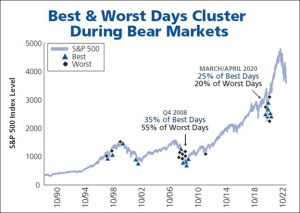
From Advisor Capital’s analysis (via Wells Fargo), you can see:
- In the fourth quarter of 2008, about 35% of the best days and 55% of the worst days were clustered tightly.
- And during March/April 2020…during the lockdown…25% of the best days occurred alongside 20% of the worst days—demonstrating how steep drops often lead to sharp rebounds.
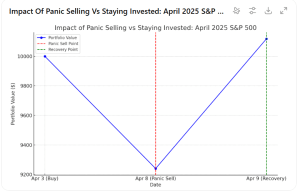
Finally, lets look at an example from just a couple of months ago. Assume that I invested $10,000 after the market closed on April 3rd. Here is what happened:
- April 4 (Friday): Markets plunged almost 6% when China responded to new U.S. tariffs.
- April 5–6 (Saturday–Sunday): Weekend—no trading.
- April 7 (Monday) and April 8 (Tuesday): Trading continued, but stocks opened lower and slipped further, extending the sell-off as tariff uncertainty persisted.
If I panic sell at the end of Tuesday, my $10,000 investment has dropped to $9,240 and I have a permanent loss of capital of $760. Just for fun, let’s look at what happened on the next day:
- April 9 (Wednesday): A dramatic +9.5% rebound arrived after President Trump announced a pause in most tariffs.
So, if I didn’t panic sell, my investment would now be worth $10,118…an increase of 1.18%! For readers who prefer charts, it looks like this (with the help of AI):
The message is clear: volatility is inevitable, but permanent losses are not. The real danger isn’t in the market’s ups and downs—it’s in how we respond to them. Whether you are a professional money manager of billions or are building toward your first hundred thousand, the same principles apply: stay diversified, stay focused, and for heaven’s sake—don’t let panic be the reason you permanently fall behind.
Or, to paraphrase Buffett, rule #1 is simple: Don’t lose money—especially not permanently.
Have a great weekend. – CHRIS
[1] Buffett’s 2023 Letter to Shareholders. [2] Steven Lo, “Along the Margins”, July 21, 2025. [3] Colonel Potter, M*A*S*H*…although I am still not sure exactly what it means.

