

Since we’re in the dog days of summer and many of us are anticipating an upcoming vacation, I thought I’d write about my recent holiday.
I visited Bangalore, a vibrant city in southern India. I’ve been travelling there since childhood and have seen its remarkable transformation over the past 30 years. Back then, we navigated wild routes, including an overnight bus. Now, there are direct flights to major cities like London, Frankfurt, Hong Kong, Tokyo, and San Francisco. Bangalore has evolved into one of the world’s biggest tech hubs.
 Let’s step back for a moment. To truly understand India, a brief history lesson is helpful. Before British rule, the Indian subcontinent was a mosaic of nation-states with unique cultures, traditions, languages, ethnic groups, and cuisines. The one thing that united them was resentment toward the British, who plundered an estimated $45 trillion USD from the region.[1] It brings a whole new meaning to the rapper Biggie’s famous song, “Gimme the loot!”. India gained independence shortly after World War II, with the British leaving behind 90% of the population in extreme poverty.[2]
Considering India as a collection of nations, like the European Union, rather than a single country, is more accurate. Just as French culture differs from Latvian culture, India’s regions are similarly diverse. Despite a common starting point after independence, the realities across different regions in 2024 are markedly distinct.
In 2022, India’s GDP per capita was $2,410 USD. To put that in perspective, it’s equivalent to living on less than $300 CAD per month! While India is extremely poor overall, the South and West are significantly wealthier. Bangalore, for instance, had a GDP per capita of $25,450 in 2022, comparable to Spain and Portugal.[3]

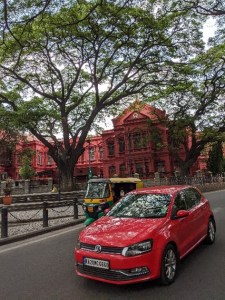

Walking the streets of Bangalore, the new middle class is evident. I use informal indicators like iPhone usage, pet ownership, and Starbucks presence to gauge middle-class strength. In Bangalore, all of the above are abundant.
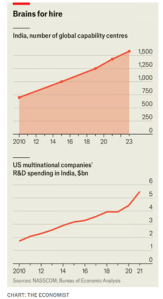 So, where did this wealth originate? Global capability centers offshore white-collar work, from data analytics to R&D. Everything from managing Lululemon’s supply chain to investment portfolio management by Wells Fargo is done in Bangalore. Mercedes-Benz has over 6,000 workers at their R&D center, and they have produced 32 patents in the last four years. It’s clear that to be a global player, having a presence in southern India is essential.[4]

The food in this region is different from what you may consider “traditional” Indian food. If you came for chicken tikka masala, you’re better off getting a Maharaja Mac from McDonald’s (one of my favorites!).
This is the south Indian staple, dosa, paired with coconut and tomato chutney and sambar. Think of dosa as an Indian crepe made with fermented rice flour. As a kid, I ate dosa with maple syrup, thinking of them as Indian pancakes…thankfully my palate has matured since then.
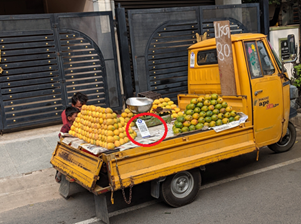 Every shop, from Nike to mango vendors, accepts digital payments via QR codes. UPI (Unified Payments Interface) enables direct, instant money transfers with just a QR code and a phone. In 2022, it processed over $1 trillion USD in payments, revolutionizing the economy in emerging markets. Its success has drawn international attention, leading to integrations with other countries’ payment systems.[5] While physical infrastructure in much of India lags behind the West, its digital infrastructure, especially in Bangalore, surpasses many experiences in Canada. Just think, your children could open a lemonade stand and be ready to receive digital payments directly to their bank account within minutes.
However, there are signs that physical infrastructure is also improving as evidenced by Kempegowda International Airport in Bangalore. It is a testament to the new, shiny India.
As we head into the heat of summer, we wish you safe and enjoyable travels. – SHIV
[1] https://cup.columbia.edu/book/dispossession-deprivation-and-development/9788193732915 . https://cup.columbia.edu/book/agrarian-and-other-histories/9789382381952
[2] https://www.forbesindia.com/article/explainers/poverty-rate-in-india/90117/1 . https://pdf.usaid.gov/pdf_docs/PNACR801.pdf
[3] https://transformative-mobility.org/wp-content/uploads/2023/12/Bangalore-Deep-Dive.pdf . https://data.worldbank.org/indicator/NY.GDP.MKTP.CD?locations=ES . https://data.worldbank.org/indicator/NY.GDP.MKTP.CD?locations=PT
[4] https://www.economist.com/business/2024/05/23/global-firms-are-tapping-indias-workers-like-never-before
[5]https://www.economist.com/special-report/2023/05/15/a-digital-payments-revolution-in-india

