
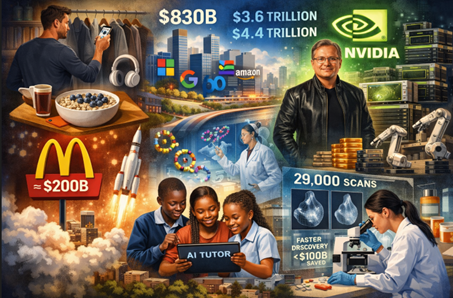
AI, AI, AI.
It is now less a buzzword than a background hum. News bulletins, dinner parties, even my new phone comes with Alphabet’s (Google’s parent firm) Gemini embedded deep in its operating system with a chip dedicated specifically to running it. Artificial intelligence no longer knocks; it lets itself in.
To make sense of both the technology and the capital behind it, I attempted a modest experiment: outsource a day to Gemini.
7:00am: Time to wake up! I ask Gemini:
- What to play in the background while I get ready. It selects my usual podcast, comfortingly unimaginative.
- I point the camera at my wardrobe; it proposes a shirt and pants combo that works quite well (I get compliments later).
- Breakfast is determined by fridge inventory (oatmeal with blueberries).
- For my commute, it suggests walking. The algorithm, it seems, favours both efficiency and cardiovascular health.
- I get lost while walking to work. Using the camera on my phone, Gemini scans the local landmarks and pinpoints my location on a map and then suggests the fastest route.
Midday: I was in a rush this morning, so I didn’t make lunch. Gemini told me to: 
- Grab a couple Korean snacks I had in the cupboard. The machine is efficient, occasionally helpful and faintly bossy.
- It also proceeded to remind my that I had not gotten out of my chair in 76 minutes, and that I was behind on my daily water intake goals.
At Work: AI tools helped me be more efficient:
- Microsoft Copilot makes grammar and spelling suggestions for my outgoing emails
- Salesforce Macros builds efficient workflows based on my most common repetitive tasks
- Our AI Assistant transcribes my conversations with clients accurately, so that our team doesn’t have to rely solely on my ‘chicken-scratched’ hand-written notes, or my memory!
- I need an image for this client communication, but I can’t find a suitable one online. ChatGPT scans my notes and created the one you see at the top of this page!
5:00pm: Gym time! Gemini suggests:
- Shoulders, legs and abs, followed by an hour on the Stairmaster. An odd combo. Even in the age of artificial intelligence, some suffering remains reassuringly human.
8:00pm: Dinner time, but the fridge is looking like a collection of ingredients that do not go together. Gemini suggested: 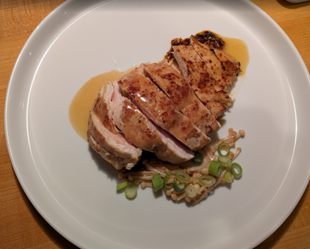
- Chicken with a miso white-wine sauce and mushrooms. The algorithm, it turns out, can cook.
- It also suggests that for a better sleep and to aid my metabolism and digestion, I eat dinner tomorrow night earlier than 8 pm!
——————————————
These small conveniences are powered by very large numbers. OpenAI, creator of ChatGPT, is reportedly valued at around $830bn [1]. To anchor that figure, consider McDonald’s. One of the world’s most successful brands, its golden arches recognized almost everywhere on earth and serves thousands of burgers every second is valued at roughly $200bn. By this admittedly unscientific measure, OpenAI equals about four McDonald’s.
Supersized valuation, hold the pickles.
Public markets are no less exuberant. Microsoft, Amazon, Meta and Alphabet together plan to spend some $410bn on AI-related capital expenditure this year. Include other major players and the total exceeds $1trn. Alphabet’s market value hovers around $3.6trn; Nvidia approaches $4.4trn. That is a great many golden arches [2].

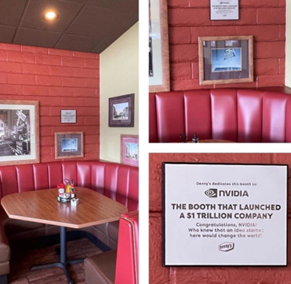
It’s unlikely you haven’t heard of Nvidia. So, what/who exactly are they and why do you keep hearing about them? From sketching plans in a booth at Denny’s to seeing its chief executive become a cultural icon in his signature lizard jacket, Nvidia has evolved into perhaps the most pivotal firm in this technological revolution.
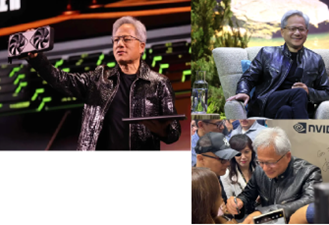
Anyone who has built a PC will have known Nvidia long before the AI boom. The screen you are reading this on is composed of millions of pixels, each requiring its own calculation. Graphics processing units (GPUs) were designed to perform those calculations simultaneously. As it happens, artificial intelligence relies on the same kind of parallel, high-volume computing. Nvidia happens to make the most advanced chips for the job.
The incumbents funding this boom are not speculative minnows. Microsoft generated roughly $281bn in revenue in 2025. [3] Enough, in theory, to buy McDonald’s outright and still have change for Ford Motor Company. Nvidia, meanwhile, has ploughed hundreds of billions into the broader AI ecosystem. At this stage, this revolution is being financed largely from free cash flow. [4]
“If discovering new drugs is like searching for a needle in a haystack”, says Regina Barzilay, a computer scientist at MIT, “AI acts like a metal detector.” [5]
Yet the more interesting story may lie beyond chatbots and capex. In medicine, AI is beginning to compress time itself. Eli Lilly recently crossed the $1trn mark in market value, as investors wager on faster, more precise drug discovery. Traditionally, bringing a drug to market can take 15 years and cost roughly $2.8bn, with only about 10% of candidates surviving human trials. [6]
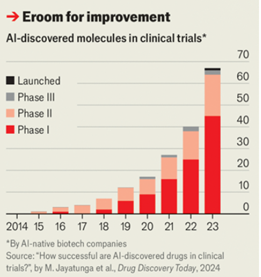
AI systems are improving those odds. Early-stage molecules designed with machine-learning tools have shown markedly higher safety success rates (85%) than historical averages (40%). McKinsey estimates suggest the pharmaceutical industry could save over $100bn annually through AI-enabled efficiencies. [6]
AI’s role extends well beyond designing the molecule itself. It can identify the most suitable candidates for clinical trials, making studies faster and less costly. It can even generate “synthetic” control patients, virtual counterparts that allow researchers to see, in real time, how a participant might have fared without the treatment. [7]
Early results in diagnostics are equally encouraging. A study from Imperial College London found that an AI model interpreted mammograms as accurately as two radiologists conducting a double reading and significantly more accurately than a single reader for detecting breast cancer. The system also reduced both false positives and false negatives. The findings were based on a substantial sample of 29,000 mammograms from the US and UK. [8]
Perhaps most promising is AI’s reach beyond rich-world offices and laboratories. All it requires is a smartphone and a data connection. Tools increasingly common even in remote areas of the global south. Personalised tutoring in everything from English to calculus, instant translation, agricultural advice: the potential to narrow educational and informational gaps is considerable. In Nigeria, a six-week after-school programme using Microsoft’s Copilot, where students interacted with the chatbot twice a week, raised English scores by the equivalent of nearly two additional years of schooling. [9]
Every transformative technology brings disruption. Some jobs will disappear; others will be created. Productivity gains may arrive unevenly. Valuations may overshoot. But beneath the noise and the trillion-dollar headlines lies something more durable: a general-purpose technology embedding itself into daily life.
I began the day trying to offload as much as possible to a machine. I ended it cautiously optimistic. Artificial intelligence may not choose my lunch perfectly. But it may, in time, help cure disease, expand opportunity and make the global economy a little more efficient.
That would be a return on investment even McDonald’s might admire.
–SHIV
[1] https://techcrunch.com/2025/12/19/openai-is-reportedly-trying-to-raise-100b-at-an-830b-valuation/ [2] https://www.ft.com/content/d503afd5-1012-40f0-8f9d-620dcb39a9a2 [3] https://www.microsoft.com/investor/reports/ar25/index.html [4] https://www.economist.com/finance-and-economics/2026/02/08/how-to-hedge-a-bubble-ai-edition [5] https://www.economist.com/science-and-technology/2023/09/13/how-scientists-are-using-artificial-intelligence [6] https://www.economist.com/leaders/2026/01/08/ai-is-transforming-the-pharma-industry-for-the-better [7] https://www.economist.com/science-and-technology/2026/01/05/an-ai-revolution-in-drugmaking-is-under-way [8] https://www.imperial.ac.uk/news/194506/artificial-intelligence-could-help-spot-breast/ [9] https://www.economist.com/finance-and-economics/2025/10/23/can-ai-make-the-poor-world-richer

