
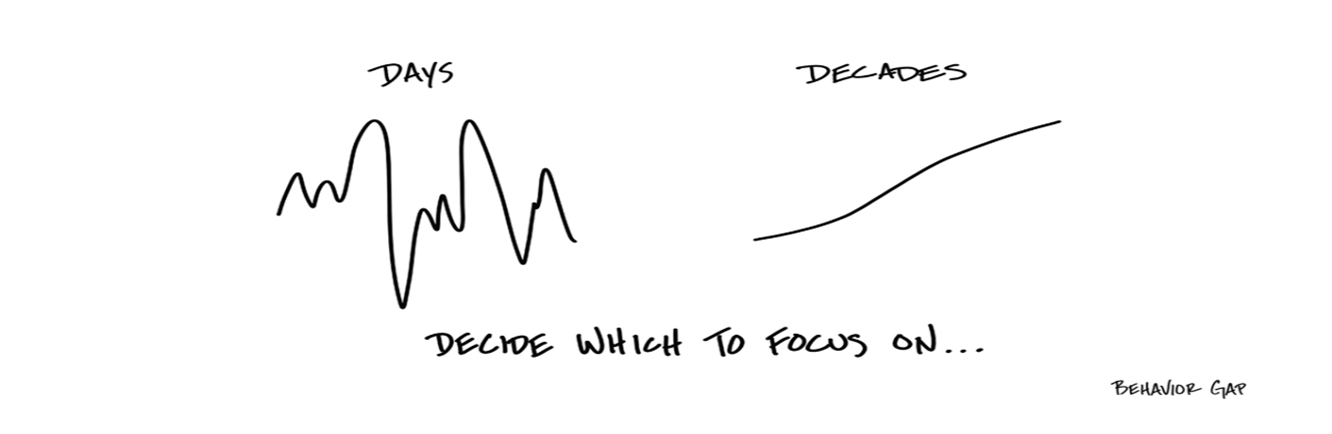
When we turn on the news today or scroll through our social media feeds, it often feels like the world is spinning faster than ever. Headlines compete for our attention: geopolitical conflicts, economic uncertainty, political division, and technological disruption. The sheer volume of information can make it difficult to process what is happening, let alone decide how to respond.
Naturally, our minds search for rational explanations to help make sense of it all. At times, one might even question whether rational thinking is possible in what can feel like an increasingly irrational world, filled with seemingly irrational players.
But is this truly any different from other periods in history? It certainly feels like it is, but for an eye-opening reality check, click here for the famous, “Lin Wells Memo”, written by the US Department of Defense, and delivered to President George Bush.
History reminds us that uncertainty is a constant companion. While the characters and circumstances change, the fundamental truths that guide sound decision-making remain remarkably consistent.
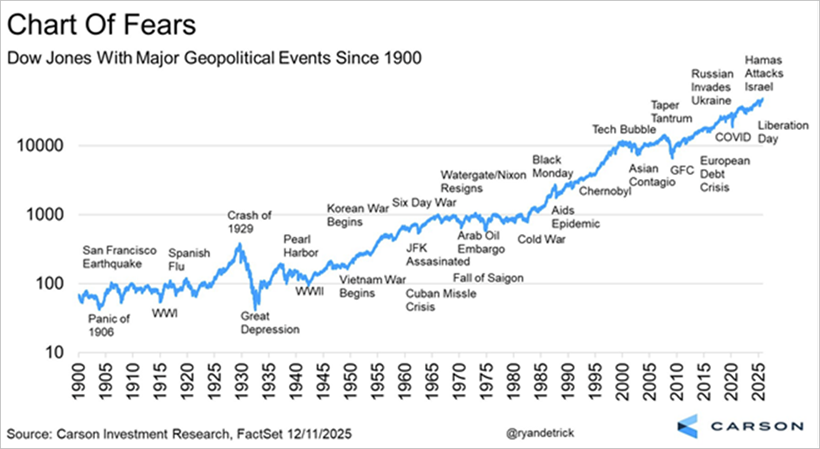
When it comes to investing, one of the most helpful mental frameworks is learning to think in terms of probabilities rather than possibilities. Literally anything is possible, but most outcomes are not probable. Markets, economies, and geopolitical events constantly present a wide range of possible scenarios, many of them dramatic. Successful investors focus instead on what is most likely to occur over time.
So how can investors reduce the probability of poor outcomes and increase the probability of successful ones?
While nothing in investing can be known with absolute certainty, we believe the best approach is to rely on a structured decision-making framework, regardless of the economic or political backdrop. If we were to base our investment decisions primarily on daily political developments or headlines, many of us would likely fall victim to what is often called decision paralysis or paralysis through analysis. The sheer volume of noise can prevent thoughtful action.
Political events can certainly influence markets, but more often they affect the short-term rather than the long-term trajectory of strong businesses and productive economies. Companies that succeed over time make decisions based on where they want their business to be in five or ten years. If they constantly adjusted their strategy based on the politics or events of the moment, they would risk losing focus and delaying long-term success.
As investors, we should think about our personal finances in a similar way. Our cash flow and balance sheet are, in many respects, like those of a business. A healthy business allocates resources toward future growth and spending needs. If nothing is set aside to invest for the future, the future itself becomes limited.
This is where discipline and structure become essential.
As financial advisors, part of our responsibility is to help create a framework that keeps you on track toward your objectives while also allowing us to collectively operate within a very tight emotional bandwidth, especially when markets are volatile. One of the most important tools in this process is an Investment Policy Statement (IPS). Investopedia defines an IPS as “a crucial document in portfolio management outlining investment goals, asset allocation, and strategies.”
Having these guidelines in place provides clarity and direction. When you know where you are going, only certain roads will reliably get you there. When you do not know where you are going, any road will do.
A recent real-world example illustrates how this framework helps guide decisions.
Many clients held positions in energy investments focused on oil and gas. As we have seen, recent geopolitical tensions in the Middle East and the conflict involving Israel, the United States, and Iran pushed the price of oil significantly higher. Since last Friday’s close (Feb 27 to March 5 – Globe Investor), the price of a barrel of oil rose roughly 18%, with WTI crude approaching $80 USD and still on the move.
Before this conflict, many analysts expected lower oil prices in the coming years. For instance, BMO Capital Markets predicts an average WTI price of around $60 in 2026 and $65 in 2027. Although the current spike might last a while, prices are likely to return to normal if geopolitical tensions ease.
When markets experience short-term surges caused by unexpected events, it can be a good opportunity to step back and reassess risk. In this situation, we opted to take advantage of the increase by reducing exposure and reallocating to more diversified holdings within the portfolio.
Most client portfolios are built with a strategic asset allocation, but we often structure them using what we call a “core and explore” approach. The core portion of the portfolio rarely changes and is designed to provide long-term stability and growth. The exploration portion allows for selective opportunities and adjustments as conditions evolve. The energy reallocation described above is an example of that process in action.
I recently encountered an intriguing idea in the Journal of Financial Planning from October 2022. In the article, business psychologist and productivity coach Barbara Kay introduces the acronym ROPE to help organisations navigate periods of change. ROPE stands for Realistic, Optimistic, Productive, and Efficient.
We believe this framework also applies well to navigating the ups and downs of investing.
- Realistic: Investment portfolios will never move in a straight line, neither upward nor downward. Markets fluctuate as economies evolve, and volatility is a normal part of the journey. Our reality lies between these ups and downs. Over time, when we draw a line from the beginning of the journey to the end, progress becomes clear.
- Optimistic: As the saying goes, optimism is often the most practical form of realism. There will always be voices urging you to abandon your plan or react emotionally to short-term events. Tuning out that noise and staying focused on long-term goals is essential. Despite wars, recessions, and countless market corrections throughout history, markets and economies have consistently moved forward and reached new highs.
- Productive: Productivity is created by translating strategy and effort into meaningful results over time. Many people will help along the way, but ultimately, you remain the driving force behind your financial future. Productivity comes from purpose, discipline, and belief in the long-term plan.
- Efficient: No one succeeds alone. The most effective approach is to leverage your own strengths while leaning on others’ strengths. Family members, friends, and trusted professionals can help us move toward our objectives more efficiently. Surrounding ourselves with capable and positive people often amplifies both our energy and our results.
The world around us is changing quickly, and there will always be challenges ahead. But in truth, it has always been this way.
History moves forward through uncertainty. Markets move forward through volatility. Progress moves forward through persistence.
So, while headlines may dominate our attention in the short term, our focus remains firmly on the long term.
Be realistic.
Be optimistic.
Be productive.
Be efficient.
And most importantly, stay invested in a disciplined plan designed to help you reach the future you are working towards.

