
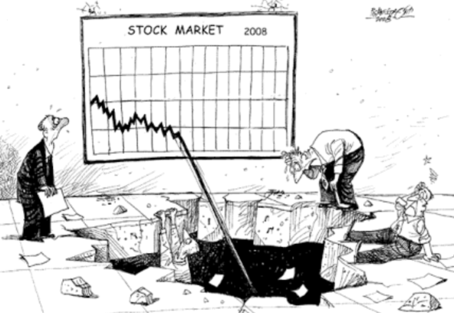
The S&P 500 was up 17% from January 1st to October 31st 2026 (surviving one big dip in March due to rising oil prices from the conflict in Iran).

S&P500 January-October 31 2026
The last few weeks in capital markets have been difficult, to put it mildly. Every time I check the markets, it seems another shade of red has appeared. French sovereign debt, American politics, Nvidia controversies, Anthropic’s IPO plans. The headlines have been coming faster than anyone can reasonably keep up with. I could dedicate an entire commentary to each of these developments, but that isn’t really the point. The point is that markets have had a rough go of it in November.
Note: This commentary is being written on the morning of November 23rd, with markets having rebounded by more than 6% since Friday November 20th . Markets certainly have a sense of humour when it comes to deadlines.
The three worst days, this past month [1]:
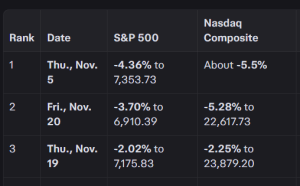
Over the course of just three trading days, the market surrendered its gains for 2026, pushing major indices into negative territory for the year. At one point, the S&P 500 came within 2.64 percentage points of triggering a market-wide circuit breaker.
For those unfamiliar, circuit breakers are essentially emergency cooling-off mechanisms designed to prevent panic from turning into a disorderly market collapse. A 7% decline in the S&P 500 from its previous closing level triggers a 15-minute trading halt. The threshold rises to 13% for a second halt, while a 20% decline would shut markets down for the remainder of the trading day. [2]
These mechanisms were put to the test during March 2020, when circuit breakers were triggered four times as the world grappled with the onset of COVID-19. Yet, despite the extraordinary uncertainty and economic disruption, markets eventually recovered and went on to reach new highs. [3]
There is, however, something interesting happening when I look beyond the headlines and examine our clients’ portfolios. Despite the turbulence, many remain positive for the year. So, what gives?
Active management.
You’ve probably heard one of us make this argument during a meeting. At TFP, we believe in entrusting capital to experienced investment managers with strong, established track records. We invest alongside these managers ourselves, and we believe there is value in having professionals whose entire working day revolves around researching businesses, assessing valuations and making decisions about what to buy, sell or hold.
Unlike a passive index fund, which generally follows the market wherever it goes, an active manager has the flexibility to make decisions based on changing market conditions. That flexibility can be particularly valuable during periods of heightened volatility. When investors are indiscriminately selling, quality businesses can become available at attractive valuations. A manager with the discipline and conviction to take advantage of those opportunities may be able to limit losses and position a portfolio for a stronger recovery.
Of course, active management is not a guarantee of outperformance. Not every manager gets it right. But we believe that selecting the right managers, with proven processes and a willingness to adapt, can make a meaningful difference over a full market cycle.
Consider the so-called lost decade between 2000 and 2009. The S&P 500 delivered virtually no return over that period when measured by price appreciation. Investors who relied exclusively on the index had a difficult decade. [4]
Since entering the industry, this is the first significant market correction I have experienced firsthand. And, if I’m being honest, I’m nervous. I think that’s a perfectly normal reaction. After all, I’m human, not a particularly sophisticated algorithm.
But being a student of history means looking beyond the immediate headlines and examining what has happened during previous periods of market stress. The dot-com bubble, the Global Financial Crisis and the COVID crash all felt different at the time. Each came with its own set of seemingly insurmountable problems. Yet, each was eventually followed by a recovery.
The lesson isn’t that markets always recover on a convenient timetable, or that every investment will eventually return to its previous high. Rather, it is that attempting to predict the precise bottom of a market correction is extraordinarily difficult. Historically, investors who remained invested through periods of volatility have generally been better rewarded than those who attempted to jump in and out.
In fact, for investors with a sufficiently long time horizon and available cash, corrections can present opportunities to buy quality investments at lower prices. In other words, sometimes the market really does put things on sale. The trick is having the conviction to shop when everyone else is leaving the store.
It brings to mind Warren Buffett’s famous advice: “Be fearful when others are greedy, and greedy when others are fearful.”
Another concept that helps put these periods into perspective is the business cycle. Economies move through periods of expansion and contraction. During expansions, economic activity grows, corporate earnings generallyimprove and investor confidence tends to rise. Eventually, however, growth slows, valuations adjust and certain sectors begin to fall out of favour. [5]

This process often brings about what investors call sector rotation. Capital moves away from areas that have become expensive or particularly sensitive to economic conditions and towards businesses considered more defensive. Think of established banks, consumer staples and other less glamorous businesses that may not make exciting headlines but can provide a degree of stability.
This is another area where active management can play a role. Managers who are able to identify changing economic conditions and adjust their portfolios accordingly may be better positioned to navigate the transition between different stages of the cycle.
And here is perhaps the most important distinction: contractions are not necessarily evidence that something has gone terribly wrong. They are a normal part of the economic and market cycle. Expansions do not last forever, and neither do downturns. While the timing and severity of each cycle are impossible to predict with precision, history suggests that economic growth and corporate innovation have continued despite repeated periods of disruption.
In fact, I would argue that a market that never experiences a meaningful correction should make us more suspicious, not less. It would suggest that we are operating in an environment unlike anything we have previously experienced, where the lessons of history may no longer apply.
I’ve always known that another correction would eventually arrive. I just didn’t know when. Perhaps this is it.
So, if I’ve known all along that these periods are inevitable, why am I still nervous?
Because knowing something intellectually and experiencing it emotionally are two very different things. It’s easy to talk about market corrections when markets are climbing. It’s considerably harder when your screen is covered in red and the financial news seems determined to make matters worse.
You may be feeling the same way. If so, you’re certainly not alone.
When I start feeling that anxiety, I remind myself to step away from the daily headlines, revisit the lessons of history and focus on what actually matters: the quality of the investments we own, the managers overseeing them and the long-term objectives those investments are intended to achieve.
Markets will rise, markets will fall, and there will always be another headline explaining why this time is different. Our job is not to predict every twist and turn. It is to remain disciplined, make thoughtful decisions and avoid allowing short-term noise to derail long-term plans.
After all, the market doesn’t know how often you check your portfolio.
But your blood pressure certainly does.
-Shiv
[1] https://www.cnbc.com/2026/11/18/stock-market-today-live-updates.html [1] https://www.inquirer.com/business/stock-market-sp-correction-ai-nvidia-anthropic-loss-20261120.html [2] https://www.investor.gov/introduction-investing/investing-basics/glossary/stock-market-circuit-breakers [3] https://www.reuters.com/graphics/USA-MARKETS/0100B5L144C/ [4] https://www.tdsecurities.com/ca/en/economic-lost-decades-what-worked-when-nothing-worked [5] https://soleadea.org/cfa-level-1/business-cycles

