

4.794
That is the most important number in your life that you have probably never heard of.
As of writing, it represents the yield on the U.S. 10-year Treasury. [1]
The U.S. 10-year Treasury is widely regarded as the benchmark for borrowing costs around the world. It is one of the most actively traded and liquid investments on the planet, and the U.S. government is generally considered one of the safest borrowers. In other words, this is about as close as financial markets get to establishing a baseline price for money.
Almost everything else gets priced relative to it.
When a company, government or individual borrows money, the interest rate they pay is influenced by the 10-year Treasury. The riskier the borrower, the more they have to pay above that baseline. This is how the 10-year Treasury can find its way into your mortgage, car, or student loan. It also affects how much governments spend servicing their debt, which will influence decisions about everything from new hospitals to highways.
If our provincial government needs to build a new hospital, the interest rate on that debt is relative to the 10-year Treasury. Finance has a rather impressive way of making everything connected.
Why is the bond market so important?
The 10-year Treasury yield tells us roughly what investors can earn for taking very little credit risk over a long period. Everything riskier –stocks, corporate bonds, real estate and private investments– must compete with that return. If Treasuries yield 4.5% or 5%, a stock has to offer a much more attractive expected return to compensate for its additional risk. That can put downward pressure on high valuations, particularly growth stocks.
It is also many times larger than the stock market, and the amount of money changing hands is difficult to comprehend. Roughly US$90 billion of 10-year U.S. Treasuries trade in secondary markets every day.[2]
To use my favourite metric for conceiving large amounts of money, that is about half of McDonald’s total worth traded daily. Amazingly, that is just one issue of the U.S. government bond market.
So, what has everyone worried?
Remember how we normally think about investment risk? A stock that moves 5% in a day is having either a very bad or very exciting day.
Bonds are supposed to be considerably calmer. Lately, the U.S. 10-year Treasury has been anything but.
A movement of just a few tenths of a percentage point in bond yields can have an impact equivalent to several percentage points of movement in a stock. When you are borrowing billions of dollars, a tenth of a percentage point is not a rounding error. It can mean millions of dollars in additional interest.
Over the past two months, the 10-year Treasury yield has risen from roughly 4.3% to 4.8%. That is a significant move in an asset that is supposed to be the financial equivalent of watching paint dry.[3]
It is also why this number has been receiving so much attention in financial markets and indeed, in the popular press.
A quick side note:
To understand what is happening, it helps to distinguish between monetary policy and fiscal policy. Monetary policy is controlled by the independent central bank. In the U.S., the Federal Reserve. Its main job is to manage interest rates and keep inflation under control. Fiscal policy is controlled by the elected government. It deals primarily with government spending, taxation and borrowing.[4]

The U.S. government currently has roughly $ 40 trillion of outstanding debt.[5] Whether that is an appropriate amount is a debate for another day. What matters is that the larger the debt pile becomes, the more expensive it becomes to service; and the higher the 10-year Treasury, the more interest that needs to be paid.
Think of it like a household with a very large mortgage. Even if the family stops borrowing, they still have to make the payments and when the mortgage renews at a higher rate, it starts to get very uncomfortable.
The U.S. government faces the same problem, just with considerably more zeroes.
Although the sitting U.S. President wants lower interest rates, the Federal Reserve cannot simply do it to make the government’s debt cheaper. Its job is to control inflation and maintain price stability. With inflation still proving stubborn, giving the government a discount on its borrowing costs is not exactly at the top of the Fed’s to-do list.
Enter the Treasury Secretary
This is where things have become interesting.
U.S. Treasury Secretary Scott Bessent, who oversees fiscal policy, has recently taken steps aimed at influencing the bond market. This has left some investors scratching their heads. Not necessarily because governments never intervene in bond markets, but because the scale of the intervention is relatively small compared with the problem.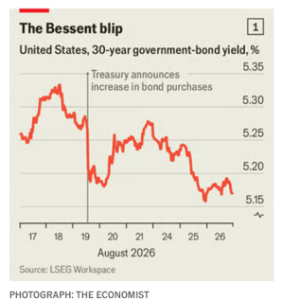
He is increasing the Treasury’s bond buybacks to roughly $4 billion per issue.[6] The basic idea is straightforward: buy back some existing debt, and potentially put downward pressure on long-term interest rates.On the surface, this makes sense. The problem is the scale.
The U.S. has roughly $40 trillion of debt. Buying back $4 billion is equivalent to trying to empty a swimming pool with a coffee mug. It may technically work, but you are going to be there for a while.
The market initially responded positively, with yields falling. But the move didn’t last. Bond investors quickly pushed yields higher again, suggesting that they were not convinced the Treasury’s actions were enough to materially change the underlying picture.[7]
And then there was the Fed
There was, however, some better news for markets.
New Federal Reserve Chair Kevin Warsh recently gave his first major speech at the annual central bankers’ conference in Wyoming. Investors had been uncertain about how he would approach inflation and interest rates.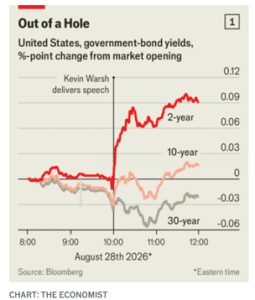
His message was relatively clear: higher rates may be necessary to keep inflation under control.
That may not sound like good news for borrowers. But it was reassuring for investors who had been concerned that the Fed might be tempted to cut rates too aggressively and let inflation become a more serious problem.
And this brings us back to our favourite number: 4.794.
Despite the Fed signalling that short-term interest rates may need to remain higher, the 10-year Treasury barely moved![8]
That is important.
It suggests that investors are willing to accept higher interest rates in the near term, while remaining relatively confident about the longer-term outlook. In other words, the bond market appears to be saying: We believe the Fed will eventually get inflation under control.
The takeaway
The 10-year Treasury yield may seem like an obscure number reserved for us finance nerds. In reality, it is one of the most important prices in the global economy.
It influences the cost of borrowing for governments, businesses and, without a doubt, you and me. It affects our investment returns, how our taxes are spent and the broader economy.
More importantly, the direction of the 10-year Treasury tells us something about how investors view the future.
Right now, the story is reasonably encouraging. Short-term rates may remain elevated as central banks fight inflation, but long-term bond yields have remained relatively stable. That stability suggests investors still have confidence that inflation can eventually be brought under control.
Next time you see the 10-year yield flash across a financial headline, know that it is, in many ways, the price tag attached to money itself.
That makes it rather difficult to ignore.
-SHIV
[1] https://www.cnbc.com/quotes/US10Y?qfsearchterm=
[2] https://www.newyorkfed.org/medialibrary/media/research/staff_reports/sr1170.pdf?sc_lang
[3] https://www.cnbc.com/quotes/US10Y?qfsearchterm=
[4] https://www.investopedia.com/ask/answers/100314/whats-difference-between-monetary-policy-and-fiscal-policy.asp
[5] https://www.jec.senate.gov/public/index.cfm/republicans/debt-dashboard
[6] https://www.cnbc.com/2026/08/20/bessent-says-treasury-buyback-operation-could-be-more-than-4-billion.html
[7] https://www.economist.com/finance-and-economics/2026/08/27/scott-bessent-takes-on-the-bond-market
[8] https://www.economist.com/finance-and-economics/2026/08/28/kevin-warsh-tries-being-a-normal-central-banker

